
Pristatymo terminas visoje Lietuvoje: 5-7 d.d.
Pristatymo kaina nurodytu adresu: Pristatymas nemokamas







Aprašymas
Trumpai apie prekę
Prekė: Laistymo juosta su kompensacija, 50 m, lašintuvai kas 33 cm, 40 vnt. rinkinys. Kategorija: Laistymo juostos.
- Gamintojas: no brand
- Modelis: LK50/33/40
- Ilgis: 50 m
Drip line with pressure compensation of 16 mm diameter and 50 m length with emitters every 33 cm. Additionally, a set of 40 pcs. additional accessories as below.
Drip line made in Anticracking technology (it is resistant to all kinds of cracks caused by kinks), technology not available in other lines and pipes sold in Poland.
The drip line is extremely resistant to UV radiation. Made from a PE mixture that allows you to maintain high plasticity, which does not disappear with age.
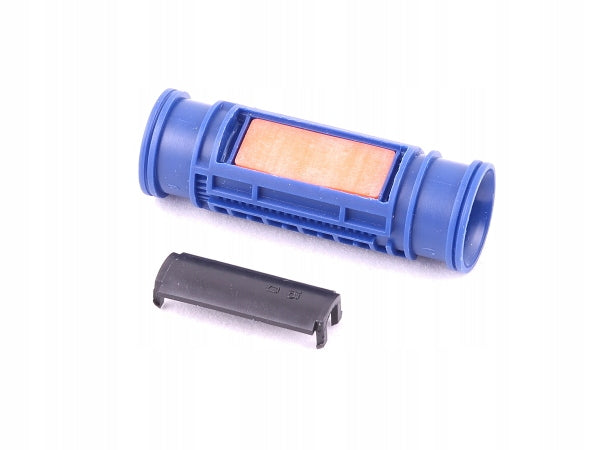
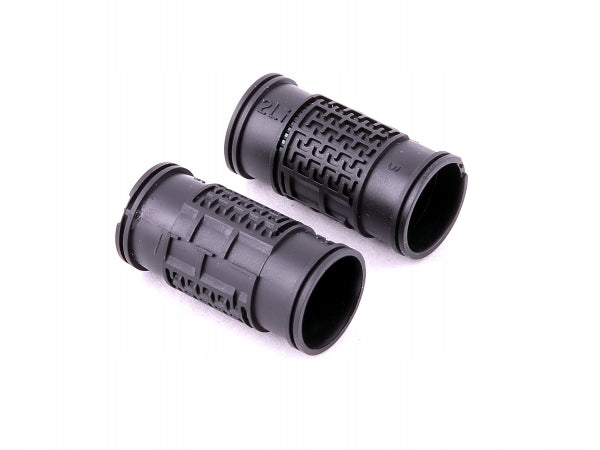
Drip line with pressure compensation operating at internal pressure up to 4,0 bar. For drips throughout the line, the best cylindrical emitters on the market were used with silicone inserts blocking the flow of water until the appropriate pressure in the pipe was reached.
The emitters are embedded in the pipe. Simply place the line between the plants to be irrigated.
Technical data:
- outer diameter: 16 mm
- inner diameter: 13,8 mm
- nominal water distribution per emitter: 2,1 l/h
- water distribution per emitter at a pressure of 2,5 bar: 2,08 l/h
- minimum working pressure: 0,8 bar
- maximum working pressure: 4,0 bar
- emitter spacing: 33 cm
- line length: 50 m
- 40 accessories
Pressed knee - 5 pieces
Press-in tee - 5 pieces
Glass (equivalent to Cork) - 2 pieces
Straight push-in connector - 5 pieces
Cork - 3 pieces
Pin for attaching the drip line to the ground - 18 pieces
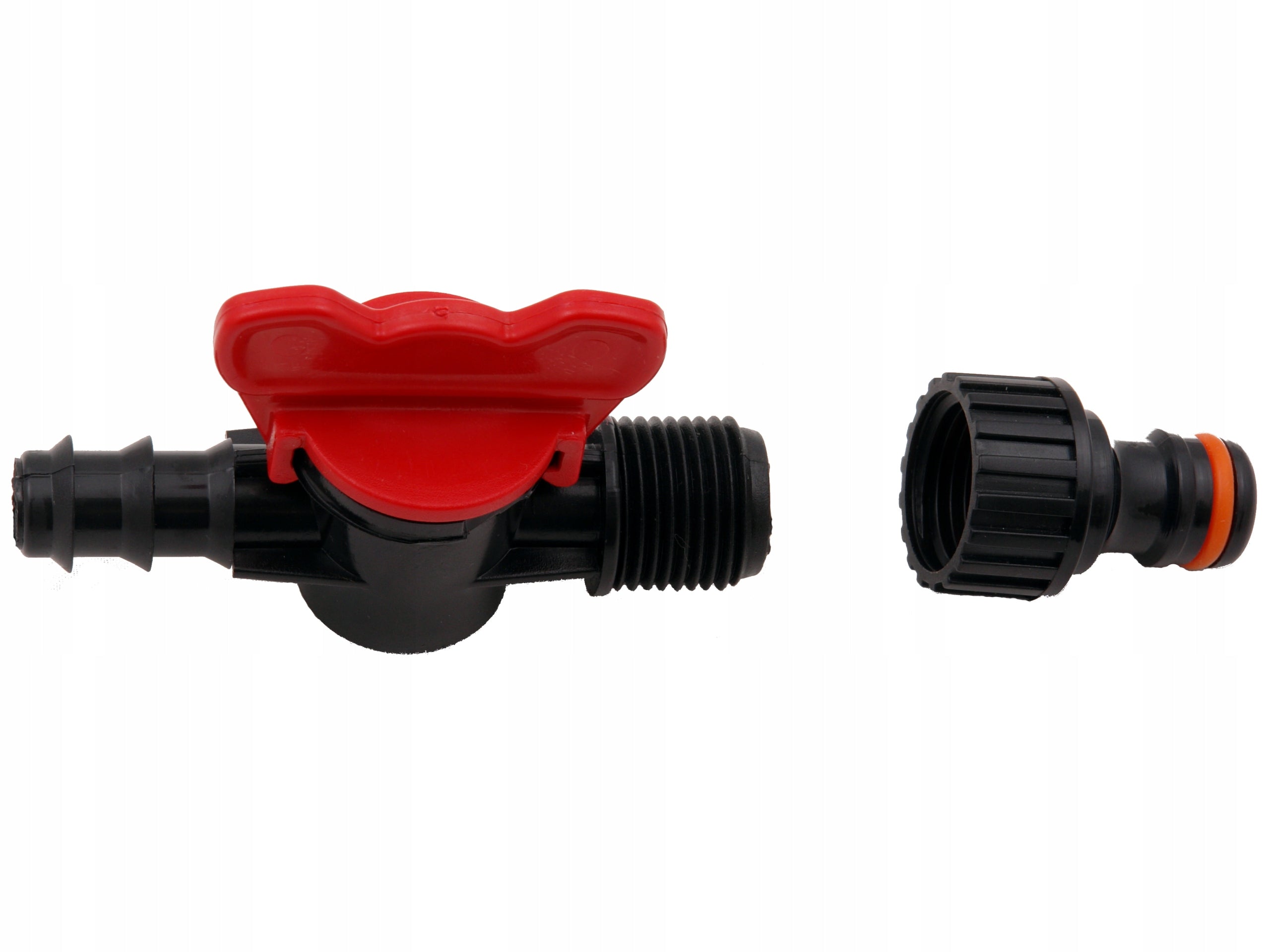
16x1/2 inch push-in valve (allows you to cut off the water supply to the drip line) - 1 piece
Quick Coupler 1/2 inch (allows you to connect your garden hose to the drip line) - 1 piece
If you need more accessories - you can buy them at our other auctions
For whom is the line with compensation and for whom without pressure compensation?
We must start our considerations by determining what compensation is? Generally speaking, a drip line that does not have pressure compensation looks like it would make holes in a pipe.
This is a very general statement, but in reality water travels through a network of labyrinths losing pressure and eventually comes out of them in the form of drops.
Such emitters, sunk, of course, in the middle of the pipe, cause that the pressure in the pipe decreases with each subsequent emitter. It decreases significantly with emitters located every 33 cm already at a distance of 50 m. The difference in the efficiency of the first and last emitter is apparently noticeable.
This causes problems with determining the degree of hydration of plants because at the beginning the plants are watered abundantly, while at the end they are poorly.
The drip line with compensation has emitters that are built in a slightly inny way.
They have additional water outflow blockers in the form of e.g. silicone rubber bands, which cause that at first water fills the pipe and then after reaching the appropriate pressure release water feeding it evenly from all emitters.
For whom then a line without compensation and for whom with compensation?
On sections up to 50 m we use a line without compensation if the deviation of water expenditure between emitters is not so important to us. From 50 meters of pipe we use a line with pressure compensation. All cases concern lines powered unilaterally, in other words, on the one hand, we give water on the other hand, we put a cork.
There are exceptions to the rule, of course.
We can move the power point of the line to its center (to e.g. We plug in a 100 meter line with a tee in its half, i.e. at 50 meters) or we can supply the line with water bilaterally, then we can use the line without compensation on a section of e.g. 100 m.
The wall thickness of the drip line?
Thickness can affect quality, but it's not quite the same. The diameter of the drip line is 16 mm and it is the outer diameter. So if the line has a thickness of 1,2 mm, then the clearance of the inner part is 13,6 mm, if the thickness is 1,0 mm is 14,0 mm and if the thickness is 0,9 mm it is a clearance of 14,2 mm.
It seems to us that these are not big differences but they are very important when transferring liquids over longer distances. Unfortunately, we will not send a line with a wall thickness of 1,2 mm of water further than a line with a thickness of 1,0, let alone 0,9 mm.
All these pipes usually operate at a nominal pressure of 2 bar and each will withstand 4 bar regardless of thickness.
The most optimal due to the transfer of liquids and strength is a pipe with a thickness of 1,0 mm.
How long can the drip line be?
The length of the drip line depends on the pressure we have in the system.
What does it really look like in a drip line?
Let's look at the drip line with compensation. The table shows the dependence of the length of the line on the pressure in the system and the spacing of emitters that affect the pressure drop.
The table shows that for emitters every 33 cm at a pressure of 4 bar, water will reach 133 m and already at a pressure of 1 bar only at 51 m.
From this we can see that the pressure has a very large impact on the length of our line.
In addition, please note that if we have an area that rises the length of the pipe will be further shortened. This is because we have to use the pressure to lift the water up.
If the terrain that rises causes the line to shorten, can the line be extended when the terrain falls? Yes, but we can determine the length of line growth experimentally.
Also, the length of the pipes will be shortened if we have branches from the line. We then have to count the total length of the line from the source along with the branches. And remember that branches are additional resistances, i.e. a shorter line.
If we have water from the mains, please take into account the pressure drops during the day and adjust with the length of the line to the lowest pressure, unless we only provide watering at night.
All these cases involve one-sided power supply. If we power the line bilaterally approximately, we can extend these sections twice for a given pressure.
Which plants are best watered using a drip line?
The root system of strawberries is shallowly embedded in the ground, so this plant requires regular watering.
When irrigating strawberries, drip tapes or drip lines arranged along the rows are therefore used.
Such irrigation does not adversely affect plants, because the water supplied does not moisten the plants, and directly affects the soil.
Drip tape or drip line also consumes much less water, the water outflow is even, because it does not depend on the wind speed.
It is important that with the use of such irrigation of plantations, you can simultaneously irrigate and harvest crops.
In addition, plants can be fertilized through drip tapes or drip lines.
Watering tomatoes is one of the very important elements of cultivation.
Inadequate amounts of water will make the fruit small and distasteful or will not bind at all.
The method of watering tomatoes depends on what stage of growth the plant is at.
Before the appearance of fruits, the plant should be watered 2-3 times a week but very abundantly.
This method of watering will contribute to the fact that water will penetrate deep into the ground and allow better root growth into the substrate.
Frequent and small doses of water will only soak the top layer of soil, which will make the roots grow sideways and come out of the ground.
With the appearance of fruits, the frequency of watering should be increased, however, the dose of water should be limited.
This method of irrigation will provide juicy fruit.
When watering, remember to avoid soaking the above-ground parts of plants.
Moisturizing leaves, shoots or fruits does not serve tomatoes and often leads to the development of fungal diseases.
Such humidification is used with drip lines.
Blueberry is a very sensitive plant to brak of water, due to the very dense and shallowly placed root system.
And it is at the place of its occurrence that high soil moisture should be maintained, which gives blueberries a chance for proper development and growth.
As in the case of raspberries, the optimal choice in terms of performance, cost-effectiveness and functionality will be the drip line selection.
If the crops are located on light soils, it is best to choose a line with an emitter spacing of 33 cm, a line with an emitter spacing of 50-75 cm, while it will work better on soils with high water capacity.
Depending on the weather and soil profile, the optimal weekly dose of water for one blueberry bush should be in the range of 10-20 l.
Due to the fact that blueberries prefer the acidic reaction of the soil, it should not be watered with hard water with a high content of calcium, iron or magnesium.
Raspberry tolerates brak water very badly.
Its high demand for water is conditioned by the fact that the plant needs water to make its fruit juicy.
To meet such requirements, while not ruining our wallet, you need to use a drip line.
This solution not only prevents the development of fungal diseases, introduces savings in the use of energy and water, but also is an excellent fertilizer carrier.
To achieve the best results, choose a drip line with an emitter capacity of 2l/h and a spacing of 33-50 cm.
Drip lines should be arranged along rows of plants on the soil surface or at a depth of up to 10 cm.
In our climatic conditions, watering has a significant impact on the growth strength, yield and condition of plants.
Due to the well-developed and extensive root system, the vine is resistant to water shortages.
Watering may be necessary in case of prolonged heat and on sandy soils.
Particular attention should be paid to vines growing right next to buildings, because the ground in such places usually dries faster.
Adequate humidity of the substrate is particularly important during the period of fruit formation.
It should be remembered that the root system is not flooded for too long, because it limits the air content in the soil and additionally creates conditions conducive to the development of soil pathogens.
By choosing ALL THE ITEMS OF THE SELLER, you can buy all the necessary elements and equipment for your garden.
- Edges for lawns and paving stones
- Agrotextiles
- Pipes
- Drip lines
- Garden Hoses
- Valve boxes
- Equipment for irrigation systems
- Many, many others
Specifications
| Group | Name | Value |
|---|---|---|
| Parametry | Condition | new |
| Parametry | Invoice | With VAT invoice |
| Parametry | Brand | no brand |
| Parametry | Length | 50 m |
| Parametry | Product weight with unit packaging | 2.3 kg |
| Parametry | Manufacturer code | LK50/33/40 |
| Parametry | Packaging status | original |