
Pristatymo terminas visoje Lietuvoje: 5-7 d.d.
Pristatymo kaina nurodytu adresu: Pristatymas nemokamas
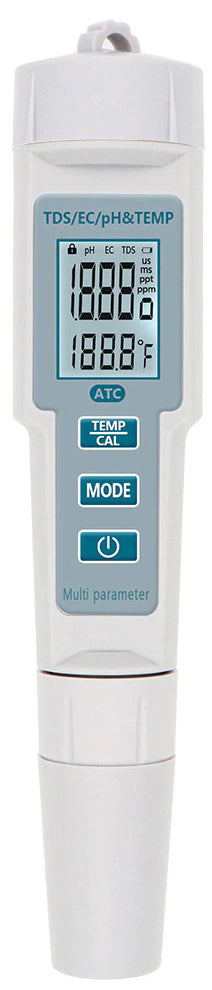
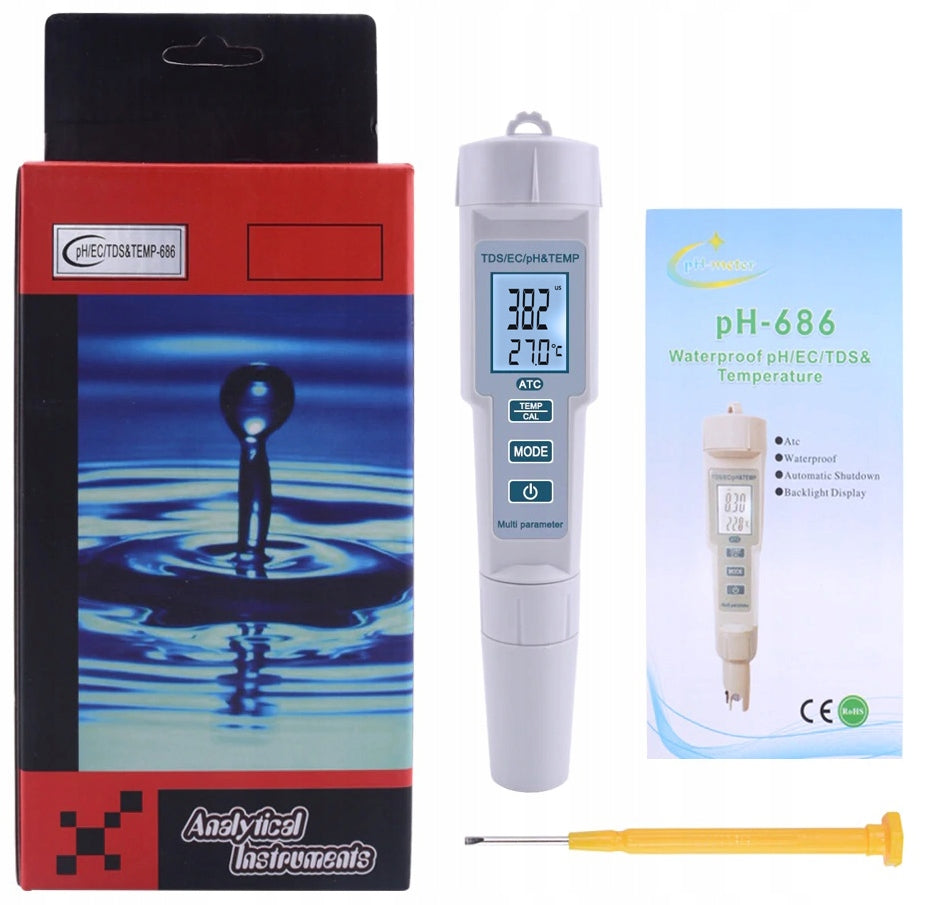


Aprašymas
Trumpai apie prekę
Prekė: Vandens kietumo, pH, TDS, EC matuoklis 4in1. Kategorija: Baseino chemija.
- Gamintojas: Tessa
- Modelis: pH-686
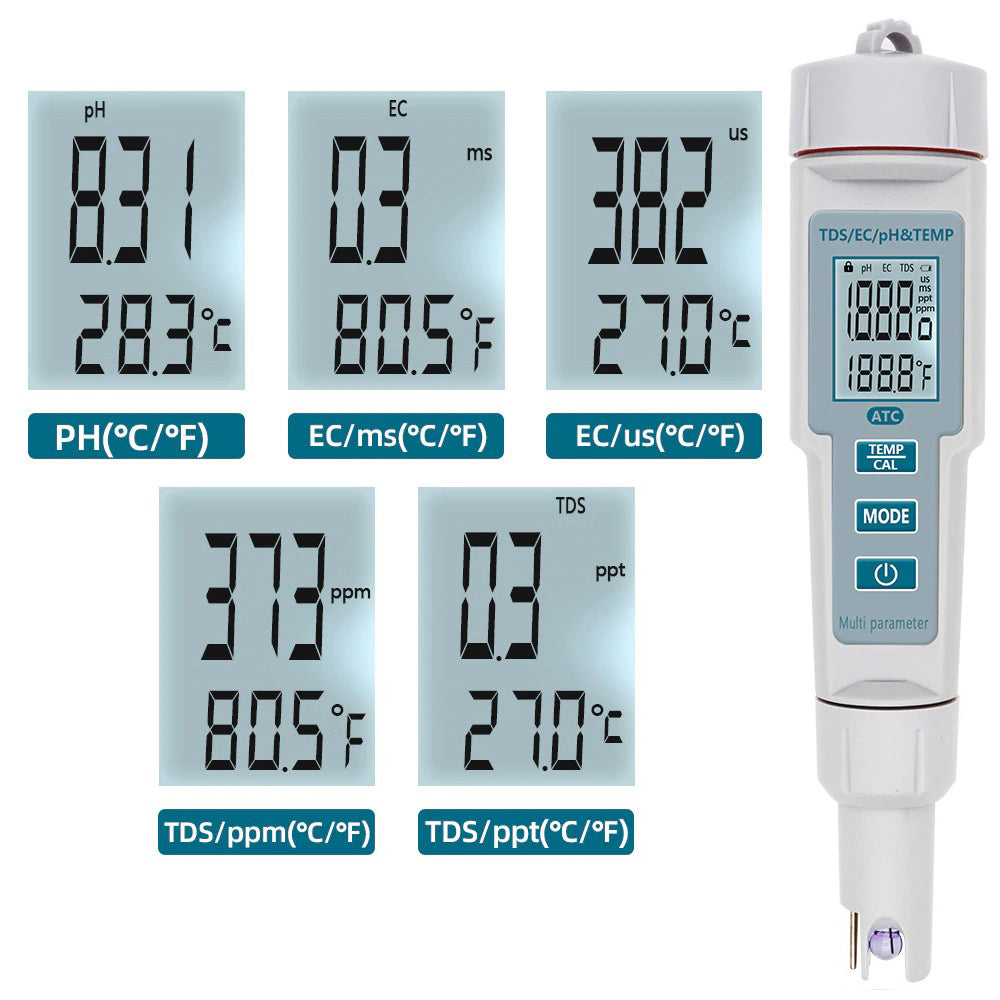
- Measurement of the total amount of all substances dissolved in water (ppm), conductivity (µS), reaction (pH) and temperature (°C)
- Conductivity EC (Electrical Conductivity)
- Water pollution (measurement of chemical concentration) TDS (Total Dissolves Solids)
- pH
- Temperature measurement in degrees °C or °F
- Waterproof housing - protection class IP65
- Automatic change of measuring ranges
- Large, easy-to-read LCD display with backlight
- Battery saving - auto-off function (turns off the meter after 5 minutes of inactivity)
- Automatic liquid temperature compensation (ATC)
- All meters are ready for use, checked and calibrated to 3 points (4,01 pH; 6,86 pH; 9,18 pH)
- Brand new product (calibrated - calibration solution HANNA HI 7031L 1413 µS/cm)
- Possibility of manual calibration up to three EC points: 1413µS/cm; 12.88mS/cm; 111.8µS/cm)
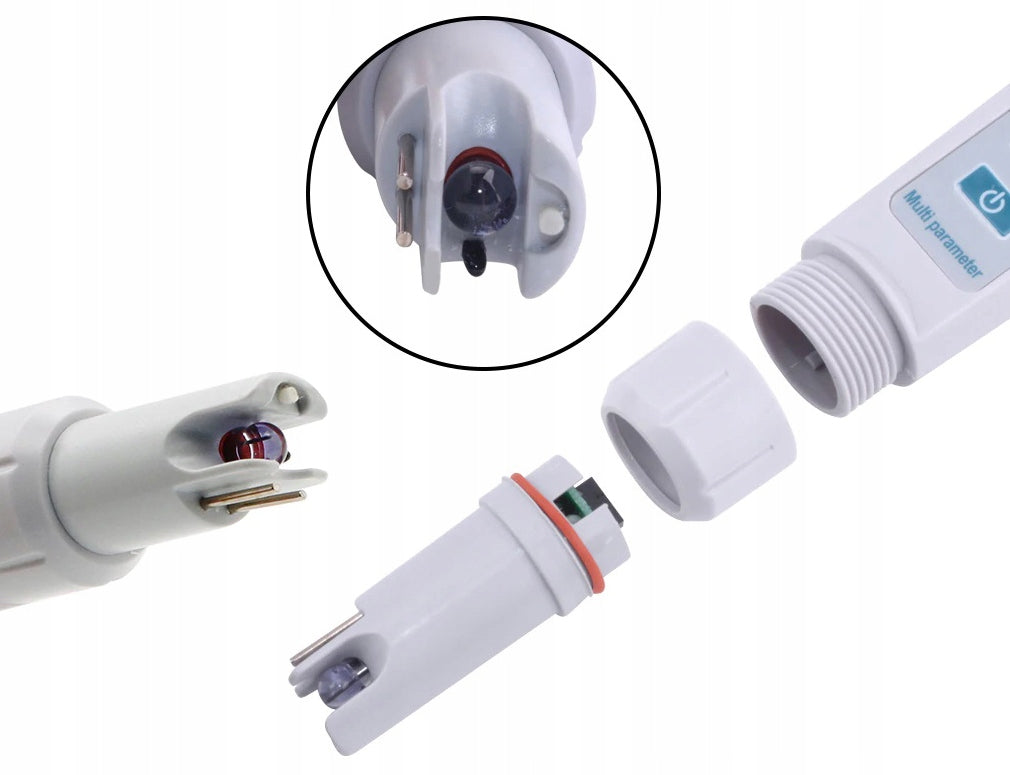
- Interchangeable measuring electrodes
- Simple operation
- Brand new, calibrated product
The exception to the use of the TDS meter is a water softener, this is due to the specificity of the tester's operation. Salt tablets are used in softeners, the meter does not distinguish ions, but counts and sums them. So the measurement of contamination behind the softener will be higher than before.
Other methods of measuring water hardness are used at the output of the softener, e.g. droplet/strip water hardness testers.
pH:
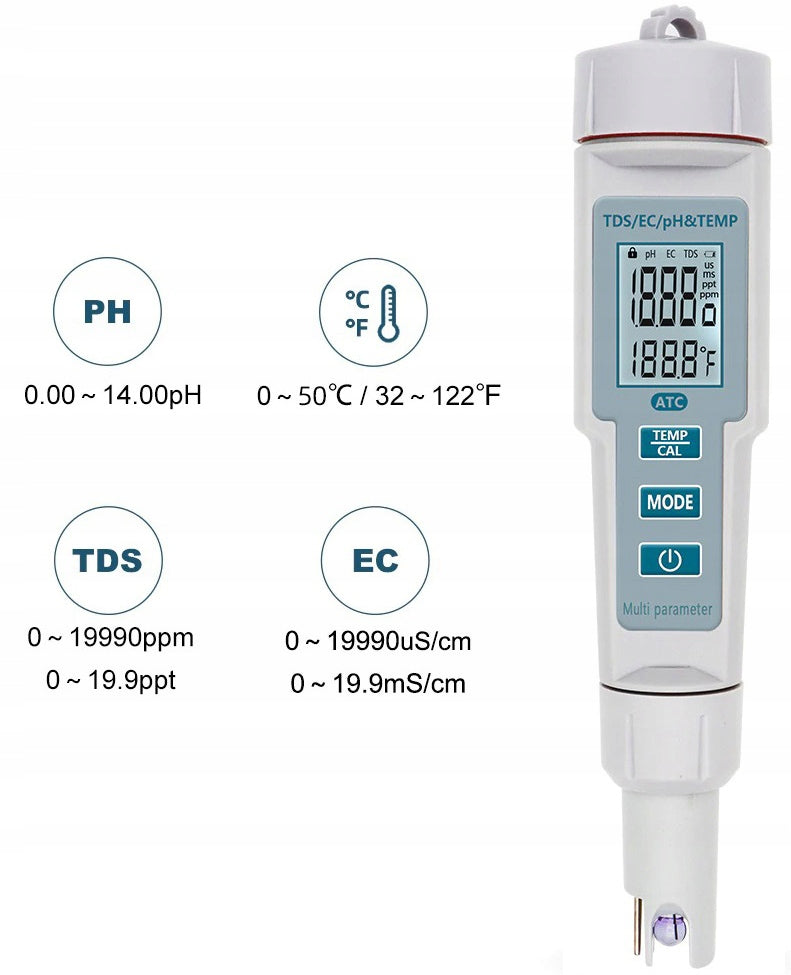
- Range: 0.00~14.00 pH
- Resolution: 0.01 pH
- Accuracy: ± 0.03 pH
EC:
- Range: 0 ~ 19990 µS/cm; 0 ~ 19.9 mS/cm
- Resolution: 1 µS/cm(< 1999 µS/cm); 10 µS/cm (>1999 µS/cm); 0.1 mS/cm
- Accuracy: ± 2%
TDS:
- Range: 0 ~ 19990 ppm; 0 ~ 19,9 ppt
- Resolution: 1 ppm (< 1999 ppm); 10 ppm (>1999 ppm); 0.1 ppt
- ppm (parts per million) = parts per million
- ppt (parts per thousand) = parts per thousand
- Accuracy: ± 2%
Temperature:
- Temperature measuring range: 0 ~ +50 °C
- Measurement resolution: 0,1 °C
- Accuracy: ± 1 °C
- TDS/EC ratio: 0 .5
- Operating temperature: 0 ~ +50 °C
- Relative humidity: < 100 %
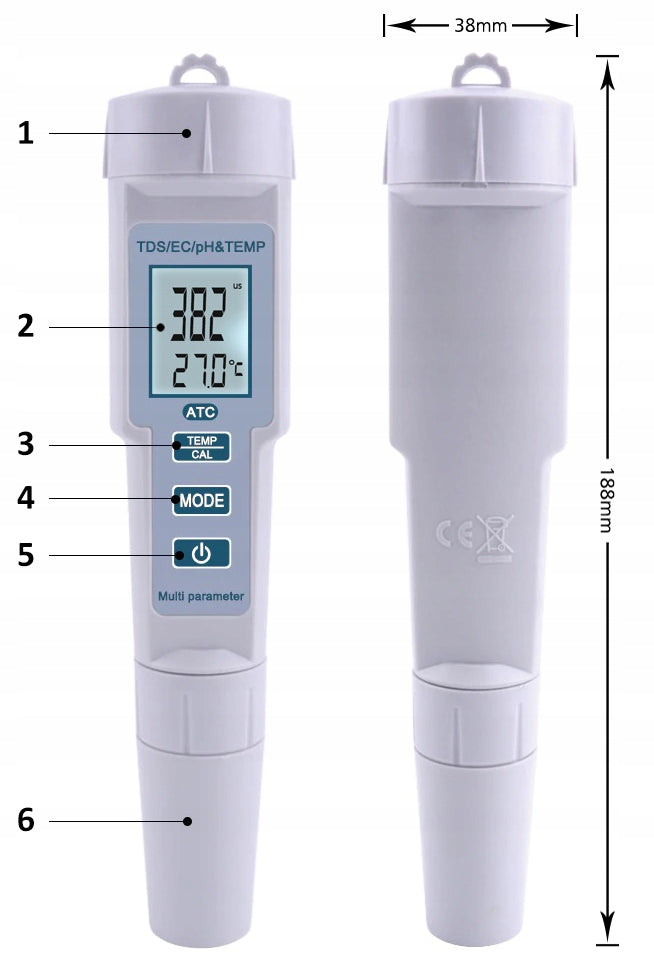
- Dimensions: 188x38x38 mm
- Weight: 82g meter (167g whole set)
- Power supply: 4*1,5V LR44 (batteries included)
- Battery compartment 4*1,5V LR44
- LCD display
- Calibration and change button °C/°F
- Change measurement mode and units (after holding for 5 seconds)
- On button
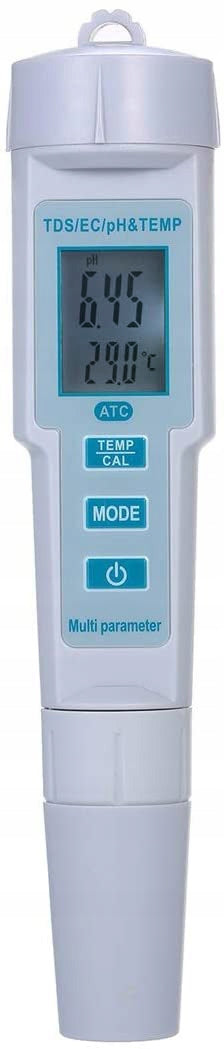
- Measuring electrode and protective cap
- Electronic tester TDS/EC/pH&Tempwith ATC function
- Buffer for calibration 4.01, 6.86 and 9,18 pH (for reconstitution with known pH)
- Screwdriver for TDS/EC calibration
- Detailed instruction in English
- Detailed instructions in Polish can be downloaded from the "Additional information" tab located at the bottom of the page.
- Determination of the amount of substances dissolved in water
- water temperature measurement
- assessment of osmotic membrane efficiency
- Marine and freshwater aquaristics
- food and chemical industry
- laboratory tests, pharmacy
- water supply, wastewater testing
- camping, travelling
- hydroponic crops
- swimming pools and spas
- gastronomy
- agriculture
- Fishkeeping
- gastronomy
- Pools & Spas
- food industry
- chemical industry
- gardening, hydroponics
- distilling and brewing
- agriculture, forestry, water protection
- pH determination of water, urine, wastewater, etc.
- wherever quality, water contamination and pH reagent assessment are needed
- sources of fresh water from streams, rivers, wells, rainwater reservoirs
- Remove the protective cap. Turn on the meter with the "ON/OFF" button
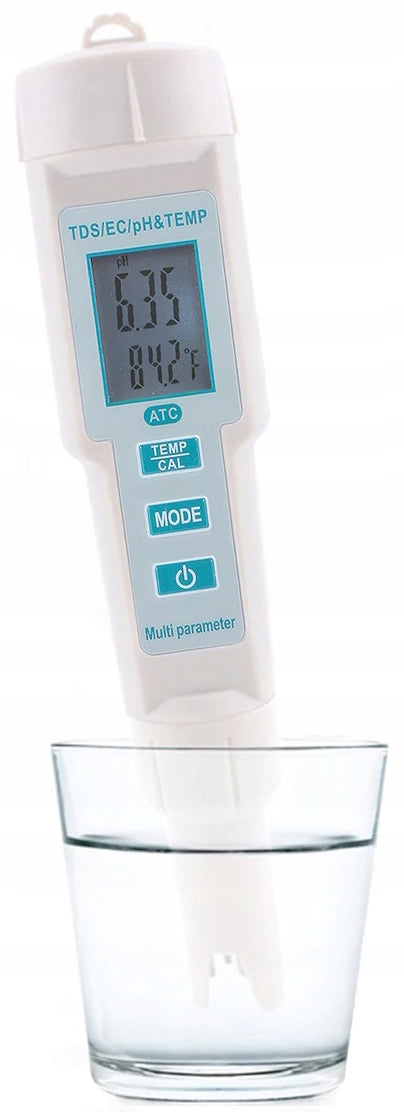
- Immerse the meter in the test liquid (do not cross the immersion line - the height of the protective cap).
- Gently stir and wait for the reading to stabilize (no changes for 5 seconds).
- Read the value from the display.
- After the measurement, rinse the electrodes with water and wipe with a cloth.
- Turn off the meter with the "ON/OFF" button.
- Put on a protective cap.
- pH
- EC
- TDS
Below are links with descriptions and conversions between liquid contamination/hardness scales (6 main scales):
http://www.mpwik.org/?page_id=174
https://pl.wikipedia.org/wiki/Twardo%C5%9B%C4%87_wody
ATC function (Automatic Temperature Compensation) - temperature measurement and compensation indication of the meter in the range of 0-50°C. This gives us a more accurate result.
Due to the pH variability of the liquid relative to its temperature, only an acid meter with the ATC function allows to obtain a reliable result consistent with the actual average value.
The pH tester complies with EU directives and is marked with the CE mark. In addition, the pH tester is made of materials that meet the strict requirements of the EU ROHS directive.
The PH/TDS/EC meter complies with EU directives and is marked with the CE mark. In addition, the meter is made of materials that meet the strict requirements of the EU ROHS directive.
- Temperature: The meter cannot be used to measure high temperature water.
- Flow rate: The meter cannot be used to measure water during its flow.
- The protective cap can be used as a handheld measuring container.
The PH/TDS/EC meter is an easy-to-use tool for quickly and accurately indicating the number of dissolved solids in liquids. Dissolved solids are mostly inorganic salts such as sodium, calcium, magnesium and potassium cations along with chlorides, bicarbonates, carbonates, phosphates, sulfates and nitrate anions.
The higher the measurement value (hard water), the worse the absorption of water by the body's cells and the greater the likelihood of its negative impact on human health
According to Polish standards, water above 500 ppm is not suitable for drinking.
The exception to the use of the tester is a water softener, which results from its specificity of operation. Salt tablets are used in softeners, the meter does not distinguish ions, but counts and sums them. Thus, other methods of measuring water hardness are used at the output of the softener, e.g. Striped water hardness testers
TDS meters measure EC (electrical conductivity) of liquids. Dissolved salts and minerals conduct electricity, the more minerals in the water sample, the higher the conductivity. The meter then converts the EC reading to TDS using the appropriate conversion rate.
High levels of TDS may indicate a large amount of organic material in the water and a lower ability of water to retain oxygen. This means that water changes are required, even if nitrate levels are low.
High concentrations of TDS can reduce water clarity, contribute to reducing photosynthesis, combine with toxic compounds and heavy metals, and lead to an increase in water temperature.
- Make 3 solutions with known pH using 250 ml of distilled water each and calibration buffers (4,01; 6,86; 9,18 pH included).
- Dip the tester electrode into a solution with pH 6,86 (at 25 ℃). Gently mix until the displayed value stabilizes.
- Press the "CAL" button until the "6,86" appears on the display and wait 5 seconds, calibration for this point has been completed.
- Clean the electrode in distilled water and dry.
- Repeat the procedure in sections 2 and 3 for solution 4,01.
- For a 9,18 pH solution, perform a calibration test if it is within the accuracy of ±0.03 pH, the calibration is correct. In case of greater discrepancy, repeat the calibration for 4.01; 6.86 pH).
- Clean the electrode in distilled water and dry. Place the meter back in the buffer solution to test the calibration. If it is incorrect, repeat the calibration.
- Remove the protective cap. If crystals appear under it, this is not a cause for concern, this is normal with pH tester electrodes. The problem will disappear after rinsing the electrode with cleaning liquid/water.
- Turn on the tester with the "ON/OFF" button and immerse the pH meter electrode in the test liquid. Gently mix until the displayed value stabilizes, then read the value from the display.
- After the measurement, rinse the electrode with water and wipe with a cloth. Put on a protective cap
- Clean the electrode with distilled water each time before and after use.
- Do not touch the sensor electrode, as the oil on the skin can damage the sensor and affect the readings.
- Store the meter with a few drops of electrode storage fluid in the protective cap (e.g. GIB KCL or Growth Technology). Lack of this action may affect the correctness of readings and the life of the device.
- Large differences in readings can be due to the need for calibration, a dry electrode or weak batteries.
Re-calibration is required for:
- battery replacement,
- very frequent measurements,
- the display shows the message "ERR",
- long periods without measurements,
- the need for very accurate measurements.
Specifications
| Group | Name | Value |
|---|---|---|
| Parametry | Condition | new |
| Parametry | Invoice | With VAT invoice |
| Parametry | Kind | tester |
| Parametry | Brand | Tessa |
| Parametry | Product form | other |
| Parametry | Manufacturer code | pH-686 |
| Parametry | Packaging status | original |